
Rob Burton
Author/Artist
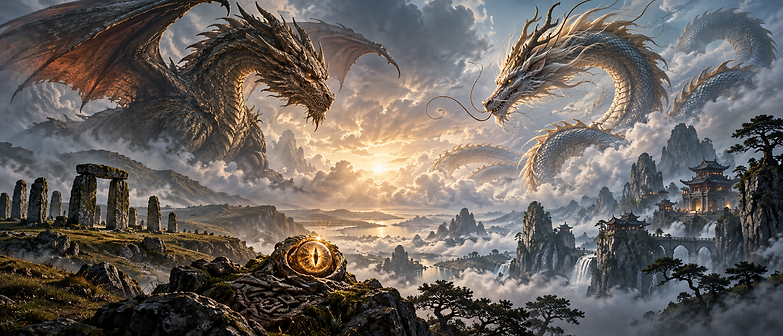
The Dragon's Eye
Chapter 1.
This is the FIRST DRAFT of the novel so it might be different when the thing is finished - so this is just a taster
I once thought that dragons only existed in myths and legends. St George slaying the dragon and all that, although that was supposedly in Libya. And, of course, the Welsh have their dragon, thanks to King Vortigern, apparently. I'm no sceptic, by the way, because I once fought a dragon and, like St George, slew it. Not with a lance or a sword, but with a splinter of ivory and a coffee bean on Wearyall Hill, near Glastonbury Tor, where the Holy Thorn once stood. The dragon was Mordred's familiar, and I killed them both. Or so I thought.
Mordred, or Modred as the Cornish call him, was one of Arthur's knights, a cunning strategist and manipulator of people. I had experienced that side of him personally, along with his considerable powers of dark magic, after finding a strange box in a spoil heap in Cornwall some time ago. That particular adventure became The Twelfth Rune, a book which, as unbelievable as the story was, made me a well-known writer and something of a local celebrity, if I say so myself.
I live with my wife, Annie, in our rebuilt cottage on the cliffs overlooking St Michael’s Mount in Penzance, Cornwall. I also happen to be a Cornish Guardian, a position I inherited rather than applied for. I can’t say much more about that but suffice it to say I seem to have acquired a few powers of my own. I also seem to have acquired Nighinn Ruaidhe, usually Nye, a red-haired thirteenth-century ghost with a bad temper, a strong sense of duty and an irritating habit of appearing whenever my life becomes particularly complicated.
I also acquired a coffee bar in town. It is run, in the main, by Lindsey. Only Annie and I know that Lindsey is a mermaid. I once saved Annie from a serial killer, but that's another story. Mermaids, and mermen, do exist because I have seen them in their natural habitat in Lyonesse, when we had an audience with Tristan and Isolde.
I know, I know. But please bear with me.
But all that malarkey was in the past. Or so I thought. I was happy and contented, living the good life as a writer, staring out of the window at the blue horizon of the Atlantic Ocean, sharpening pencils and drinking coffee. Prevaricating. Not doing much of anything at all.
Slightly bored, I opened my email to see if anything interesting had arrived, apart from the usual spam asking me to send flowers to my mother or reminding me that my car insurance was too expensive. (It wasn't.)
It came as something of a surprise to find an email from someone I had met at an international conference in Oxford a few months earlier.
Li Wei was a professor of archaeology and history at Tsinghua University in Beijing. The conference, ‘From Dragons to Djinn: Examining Folklore and Fantasy in Different Traditions’, had attracted speakers and delegates from around the world, including China. Professor Li had given a fascinating talk about Chinese dragons which, given my recent experiences, I had made a point of attending.
We had met and talked over dinner, during which I gave him an edited version of my own experiences. To my surprise, he didn't dismiss them as hallucinations. We parted promising to meet again and perhaps collaborate on something or other, but I rather thought he was simply being polite.
The contents of the email made the hairs on the back of my neck stand up, and for me, that is an important warning sign. Professor Li had some concerning news from China. There were rumours that a malevolent red dragon had been spotted, causing death and destruction in its wake.
He recalled our conversation at the conference and reminded me that I'd mentioned my own encounter with a red dragon. He wanted to know whether I could offer any insights into how to deal with such a creature. If the reports were true, he believed they should proceed cautiously and gather as much information as possible before deciding what to do.
He ended by suggesting that we meet. He would be in London in two days' time.
I quickly turned to my assistant, also known as Claude, and asked it to search for references to red dragons in China or anywhere else in the world. Bloody hell, there was one. Unfortunately, it was on the sort of website that thrives on anti-Chinese conspiracy theories.
The headline read: ‘Dragon Sighting in Rural China: Unverified Claims Cause Stir Among Locals’, and continued:
In rural China, rumours are circulating about a possible dragon sighting. The villagers claim to have seen a large, red creature soaring through the sky, breathing fire and causing chaos. However, officials remain sceptical about the validity of these claims, citing lack of concrete evidence. While investigations are ongoing, experts urge caution against jumping to conclusions without further verification.
I stared out of the window, feeling a cold shiver run down my spine. I could still feel the dragon's hot breath on my face as I shoved my arm down its maw in a last-ditch attempt to kill it. And I had killed it. With a coffee bean.
Who knew that coffee was deadly poison to dragons? I certainly didn't.
And Mordred? I had seen him hanging, impaled on the Holy Thorn tree of Wearyall Hill in Somerset. I'd stabbed him with a sliver of ivory from a holy reliquary, and he'd begun to rot and disintegrate before my eyes, his putrid flesh falling from his bones.
Nye had been there too, naturally. At one point she'd wrapped the whole bloody scene in that strange green meniscus of hers, slowing time almost to a standstill while the rest of us tried to stay alive. Ghosts, apparently, have their uses.
But I never actually saw Mordred's end. I had more pressing things to do, like saving the world. Looking back, I suppose there's a difference between watching someone fall apart and making certain they stay that way.
I needed to find out. I clicked ‘reply’ and told Li that I would meet him in London in two days' time, as he'd suggested.
I didn't know what was happening in China. But the last time dragons had entered my life, Mordred had not been far behind.
***
I hate London. It holds too many bad memories for me. In my mind, it's a place of serial killers and best friends who steal ones partner. It’s also dirty, noisy and nothing like my sanctuary from all the madness on the west coast of Cornwall. I had only been in the city overnight and already I felt grimy, sweaty and a little hungover. This was possibly more to do with the copious amounts of baijiu we had drunk at the Chinese restaurant where I had met Professor Li.
The restaurant was also owned and run by members of his extended family, which didn’t help matters. The table had been piled high with all sorts of dishes, many of which I had never seen or tasted before, despite having travelled to China on an earlier adventure. I turned down the offer of shark-fin soup on principle.
Over the sweet and sour pork and spicy cabbage, Li explained the situation. We were in a private room at the back of the restaurant, but he still kept his voice down. As an added precaution, one of the staff, a second cousin once removed, or something like that, stood outside the door while we ate, making sure we were not disturbed or overheard.
To be honest, I thought it was all a bit cloak-and-dagger. I'd convinced myself on the train up that this was going to turn out to be a wild goose chase.
Until, that is, the good professor told me about the Dragon's Eye. That's when I really started to worry, because what he told me had Mordred written all over it.
The Dragon's Eye, Li explained, was a mysterious and powerful artefact shrouded in myth and legend for centuries. He referred to ancient Chinese texts, including the Shanhaijing and Shuijingzhu, which contained references to dragons. I shrugged but went along with it.
It was the Huainanzi, a text dating from around 139 BC during the Western Han dynasty, he explained, that explored the relationship between dragons and the natural world.
‘It is in these early traditions,’ Li told me, ‘that references to what we now call the Dragon's Eye begin to appear. Although,’ he added, raising a finger, ‘I should warn you, Charlie, the sources do not agree. Some are fragmentary, some much later, and some may simply be legends copied from older legends.’
He drew closer, blowing alcohol fumes into my ear as he whispered, ‘Xuánwǔ lùn.’
He looked me in the eyes. ‘The Discussion of the Black Tortoise.’ Then he glanced fearfully at the door and raised a finger to his lips.
He got up and tiptoed unsteadily towards it. Looking back at me, he raised his finger to his lips again, nodded and snatched the door open. Our doorman jumped and spun around, his mouth a shocked O.
The eminent, but slightly drunk and perhaps paranoid professor stuck his head through the doorway and checked left and right. The hubbub of restaurant noise barely abated. Li patted the bemused guard on the shoulder, murmured something in Chinese, shut the door and came back to the table.
Once seated, he repeated, in his hoarse whisper, ‘The Discussion of the Black Tortoise.’ He nodded and leant in even closer.
‘Lóng fēi jīng,’ he said, pronouncing it ‘lohng fay jeeng’. A chummy arm was slung around my shoulders as he muttered, ‘The Book of Flying Dragons.’
I shrugged his arm off as he reached for the somewhat gaudy bottle of baijiu. Grabbing it, he refilled the little glasses we were drinking from. The increasingly ruddy-faced professor of archaeology and history raised his glass in a toast.
‘Ganbei!’ we said, clinking glasses before gulping down another measure of the fiery spirit. ‘Ganbei!’
‘It’s these books,’ he explained, ‘or at least some interpretations of them, that give us the legend of the Dragon's Eye. One tradition says it was created by the first dragon and gave its possessor power over other dragons.’
He raised a finger before I could interrupt.
‘But there are other versions. Some say it controlled dragons, while others suggest it merely allowed communication with them. One account even suggests that the dragons themselves chose who could use it.’
‘And how old is this thing supposed to be?’ I asked.
‘That is another difficulty,’ Li said. ‘The earliest surviving references may not be the earliest accounts. Some scholars believe these traditions were already ancient when they were first written down.’
‘So, nobody knows?’
‘Not with any certainty. We are dealing with stories that may have passed through several cultures and many centuries before anyone recorded them.’
‘That's quite a difference.’
‘Welcome to ancient history, Charlie.’
He pulled a notebook from his back pocket and thumbed through the pages. They were covered in Chinese characters. His notes, presumably.
‘Here, look, look…’ He pointed at a page and shoved it towards me.
‘Professor, I don't read…’
I never finished. He was already quoting his notes at me again.
‘The Dragon is the spirit of the clouds and rains, and its dwelling-place is in the waters of the underworld. When it rises to the surface, it stirs up the waves and the wind and causes rain to fall from the sky.’
Li looked up from his notebook.
‘The Discussion of the Black Tortoise, Chapter Three,’ he announced, nodding appreciatively before continuing.
‘It is said that if you can understand the language of the Dragon, you can predict the coming of rain and control the weather.’
‘Ah,’ I said.
Li thumbed through his notebook until he found what he wanted.
‘The Dragon is a creature of great beauty and grace, and its movements are like those of flowing water. It is said that the Dragon can swim upstream against the current, and that it can leap over waterfalls and mountains with ease.’
‘The Black Tortoise, Chapter Nineteen,’ he added.
He paused to gather his thoughts.
‘In this way, the Dragon represents the idea of overcoming obstacles and achieving great things through perseverance and determination.’
What could I say? I tried to look thoughtful.
‘Oh.’
More thumbing of paper occurred. This time my friend moved so close that I became distinctly uncomfortable. He was invading my personal space.
‘The Dragon is the symbol of power and authority, and its presence is felt throughout the natural world. It is said that the Dragon can control the four seasons, and that it has the power to create and destroy life.’
‘The Book of Flying Dragons, Chapter Five,’ he added.
His voice had returned to a hoarse whisper, and his hand dropped to my thigh and gripped it tightly.
‘You see?’ he hissed. ‘You see?’
I grabbed the clawing hand and removed it, shuffling away from him along the banquette seating.
‘There are later texts,’ he whispered. ‘Fragments mostly. They say that if the Eye is made whole, the dragons will answer.’
‘Answer who?’ I said.
He looked at me for rather longer than was comfortable. ‘That is the problem.’
‘Li.’
‘Dragons. Rain. Storms. Charlie, the seasons themselves. One account says that when the Eye is whole, heaven and earth move with it.’
I stared at him. ‘That sounds rather more serious than predicting the weather.’
‘It may mean nothing.’
‘You didn't sound as though it meant nothing five seconds ago,’ I said.
He reached for the baijiu again. ‘The translation is disputed.’
‘Of course it is.’
He poured himself another glass, missed slightly, and watched the clear spirit spread across the table.
‘If the wrong person believed the old accounts...’
He stopped.
‘What would happen?’
Li shook his head and folded his arms across his chest. ‘Nothing. I have drunk too much.’
Then, as if deciding the matter was closed, he unfolded his arms and pointed at another row of Chinese characters.
‘The Dragon is a creature of great wisdom and knowledge, and it has the ability to transform itself into many different forms. It is said that the Dragon can take on the shape of a human being, a bird, a fish, or even a cloud.’
‘Same book, Flying Dragons, Chapter Sixteen.’
‘Hang on, Prof. None of that actually mentions a Dragon's Eye,’ I said.
Li looked slightly offended.
‘Not directly.’
‘That's a fairly important “not directly”.’
‘The texts have to be read together, Charlie. References appear in different places, different periods, sometimes under different names.’
‘You've spent a lot of time on this, haven't you?’ I asked.
‘Many years,’ he said. ‘Probably rather too many. My family certainly thinks so.’
He smiled, but only briefly, before returning to his notes.
‘So, you're joining the dots.’
He considered this.
‘Yes.’
‘And you're certain you've joined the right dots?’
Li reached for the baijiu.
‘Reasonably.’
That wasn't quite the answer I had been hoping for.
I knew about flying dragons. I knew about creatures that had the ability to transform, and I also knew, God help me, of dragons that could take on human form and vice versa.
And it was worse than that.
Because I knew, and I was 100 per cent sure of it.
I had another glass of baijiu. And another. And another.
Mordred was back.